Building Structure
Hint
Author: Yifan Feng (丰一帆)
Proof: Xinwei Zhang
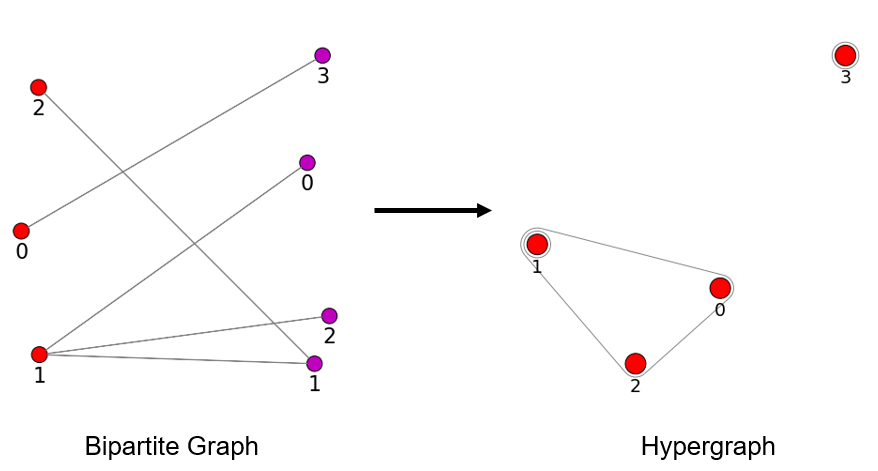
Correlation structures are the core of DHG. In this section, we introduce the basic construction methods of different structures and some structure transformation functions of them, including:
Reducing the high-order structrue to the low-order structure
Promoting the low-order structure to the high-order structure
Low-Order Structures
Currently, DHG’s low-order structures include graph, directed graph, and bipartite graph. In the future, we will add more low-order structures.
Building Graph
A graph is a graph with no loops and no multiple edges, where the edges (x, y) and (y, x) are the same edge.
It can be constructed by the following methods:
Edge list (default)
dhg.GraphAdjacency list
dhg.Graph.from_adj_list()Reduced from the hypergraph structure
Star expansion
dhg.Graph.from_hypergraph_star()Clique expansion
dhg.Graph.from_hypergraph_clique()HyperGCN-based expansion
dhg.Graph.from_hypergraph_hypergcn()
Common Methods
Construct a graph from edge list with dhg.Graph
>>> import dhg
>>> g = dhg.Graph(5, [(0, 1), (0, 2), (1, 2), (3, 4)])
>>> g
Graph(num_v=5, num_e=4)
>>> g.v
[0, 1, 2, 3, 4]
>>> g.e
([(0, 1), (0, 2), (1, 2), (3, 4)], [1.0, 1.0, 1.0, 1.0])
>>> e_list, e_weight = g.e
>>> e_list
[(0, 1), (0, 2), (1, 2), (3, 4)]
>>> e_weight
[1.0, 1.0, 1.0, 1.0]
>>> g.e_both_side
([(0, 1), (0, 2), (1, 2), (3, 4), (1, 0), (2, 0), (2, 1), (4, 3)], [1.0, 1.0, 1.0, 1.0, 1.0, 1.0, 1.0, 1.0])
>>> # print the adjacency matrix
>>> g.A.to_dense()
tensor([[0., 1., 1., 0., 0.],
        [1., 0., 1., 0., 0.],
        [1., 1., 0., 0., 0.],
        [0., 0., 0., 0., 1.],
        [0., 0., 0., 1., 0.]])
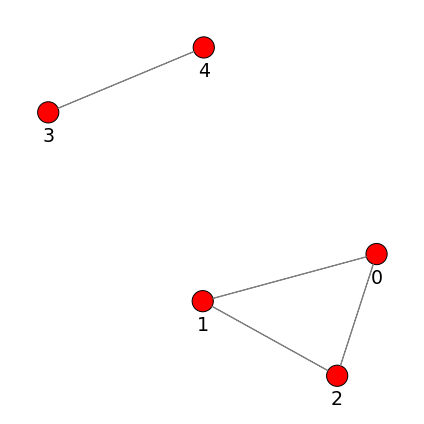
You can find that the adjacency matrix of the graph is a symmetric matrix.
The g.e attribute will return a tuple of two lists, the first list is the edge list and the second list is a list of weight for each edge.
The g.e_both_side attribute will return the both side of edges in the graph.
Important
In graph the edge is unordered pair, which means (0, 1) and (1, 0) are the same edge. Adding edges (0, 1) and (1, 0) is equivalent to adding edge (0, 1) twice.
>>> g = dhg.Graph(5, [(0, 1), (0, 2), (2, 0), (3, 4)])
>>> g.e
([(0, 1), (0, 2), (3, 4)], [1.0, 1.0, 1.0])
>>> g.add_edges([(0, 1), (4, 3)])
>>> g.e
([(0, 1), (0, 2), (3, 4)], [1.0, 1.0, 1.0])
Note
If the added edges have duplicate edges, those duplicate edges will be automatically merged with specified merge_op.
>>> g = dhg.Graph(5, [(0, 1), (0, 2), (0, 2), (3, 4)], merge_op="mean")
>>> g.e
([(0, 1), (0, 2), (3, 4)], [1.0, 1.0, 1.0])
>>> g = dhg.Graph(5, [(0, 1), (0, 2), (0, 2), (3, 4)], merge_op="sum")
>>> g.e
([(0, 1), (0, 2), (3, 4)], [1.0, 2.0, 1.0])
>>> g.add_edges([(1, 0), (3, 2)], merge_op="mean")
>>> g.e
([(0, 1), (0, 2), (3, 4), (2, 3)], [1.0, 2.0, 1.0, 1.0])
>>> g.add_edges([(1, 0), (2, 3)], merge_op="sum")
>>> g.e
([(0, 1), (0, 2), (3, 4), (2, 3)], [2.0, 2.0, 1.0, 2.0])
You can find the weight of the last edge is 1.0 and 2.0, if you set the merge_op to mean and sum, respectively.
Construct a graph from adjacency list with dhg.Graph.from_adj_list()
The adjacency list is a list of lists, each list contains two parts. The first part is the first element of the list, which is the vertex index of the source vertex. The second part is the remaining elements of the list, which are the vertex indices of the destination vertices. For example, assuming we have a graph with 5 vertices and a adjacency list as:
[[0, 1, 2], [0, 3], [1, 2], [3, 4]]
Then, the transformed edge list is:
[(0, 1), (0, 2), (0, 3), (1, 2), (3, 4)]
We can construct a graph from the adjacency list as:
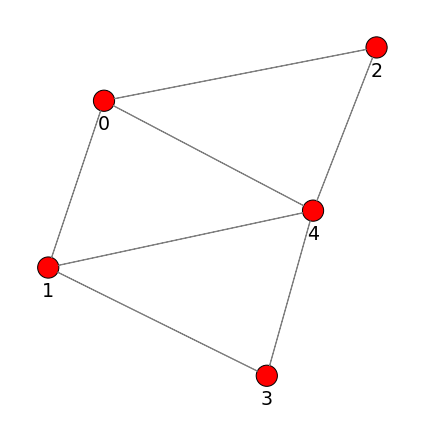
>>> g = dhg.Graph.from_adj_list(5, [[0, 1, 2], [1, 3], [4, 3, 0, 2, 1]])
>>> g.e
([(0, 1), (0, 2), (1, 3), (3, 4), (0, 4), (2, 4), (1, 4)], [1.0, 1.0, 1.0, 1.0, 1.0, 1.0, 1.0])
>>> g.A.to_dense()
tensor([[0., 1., 1., 0., 1.],
        [1., 0., 0., 1., 1.],
        [1., 0., 0., 0., 1.],
        [0., 1., 0., 0., 1.],
        [1., 1., 1., 1., 0.]])
Reduced from High-Order Structures
We first define a hypergraph as:
>>> hg = dhg.Hypergraph(5, [(0, 1, 2), (1, 3, 2), (1, 2), (0, 3, 4)])
>>> hg.e
([(0, 1, 2), (1, 2, 3), (1, 2), (0, 3, 4)], [1.0, 1.0, 1.0, 1.0])
>>> # print hypergraph incidence matrix
>>> hg.H.to_dense()
tensor([[1., 0., 0., 1.],
        [1., 1., 1., 0.],
        [1., 1., 1., 0.],
        [0., 1., 0., 1.],
        [0., 0., 0., 1.]])
Star Expansion dhg.Graph.from_hypergraph_star()
The star expansion will treat the hyperedges in the hypergraph as virtual vertices in the graph.
Each virtual vertex will connect to all the vertices in the hyperedge.
The dhg.Graph.from_hypergraph_star() function will return two values.
The first value is the reduced graph and the second value is a vertex mask that indicates whether the vertex is a actual vertex.
The True in the vertex mask indicates the vertex is a actual vertex and the False indicates the vertex is a virtual vertex that is transformed from a hyperedge.
>>> g, v_mask = dhg.Graph.from_hypergraph_star(hg)
>>> g
Graph(num_v=9, num_e=11)
>>> g.e[0]
[(0, 5), (0, 8), (1, 5), (1, 6), (1, 7), (2, 5), (2, 6), (2, 7), (3, 6), (3, 8), (4, 8)]
>>> v_mask
tensor([ True,  True,  True,  True,  True, False, False, False, False])
>>> g.A.to_dense()
tensor([[0., 0., 0., 0., 0., 1., 0., 0., 1.],
        [0., 0., 0., 0., 0., 1., 1., 1., 0.],
        [0., 0., 0., 0., 0., 1., 1., 1., 0.],
        [0., 0., 0., 0., 0., 0., 1., 0., 1.],
        [0., 0., 0., 0., 0., 0., 0., 0., 1.],
        [1., 1., 1., 0., 0., 0., 0., 0., 0.],
        [0., 1., 1., 1., 0., 0., 0., 0., 0.],
        [0., 1., 1., 0., 0., 0., 0., 0., 0.],
        [1., 0., 0., 1., 1., 0., 0., 0., 0.]])

Clique Expansion dhg.Graph.from_hypergraph_clique()
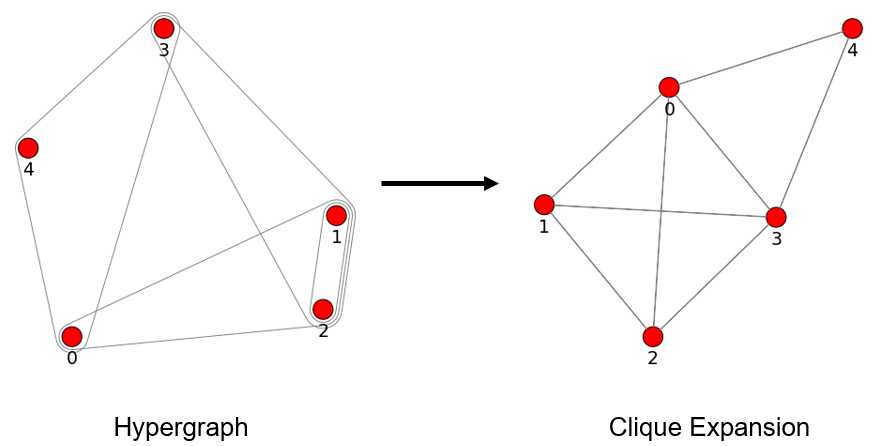
Unlike the star expansion, the clique expansion will not add any virtual vertex to the graph. It is designed to reduce the hyperedges in the hypergraph to the edges in the graph. For each hyperedge, the clique expansion will add edges to any two vertices in the hyperedge.
>>> g = dhg.Graph.from_hypergraph_clique(hg)
>>> g
Graph(num_v=5, num_e=8)
>>> g.e
([(0, 1), (0, 2), (0, 3), (0, 4), (1, 2), (1, 3), (2, 3), (3, 4)], [1.0, 1.0, 1.0, 1.0, 1.0, 1.0, 1.0, 1.0])
>>> g.A.to_dense()
tensor([[0., 1., 1., 1., 1.],
        [1., 0., 1., 1., 0.],
        [1., 1., 0., 1., 0.],
        [1., 1., 1., 0., 1.],
        [1., 0., 0., 1., 0.]])
HyperGCN-based Expansion dhg.Graph.from_hypergraph_hypergcn()
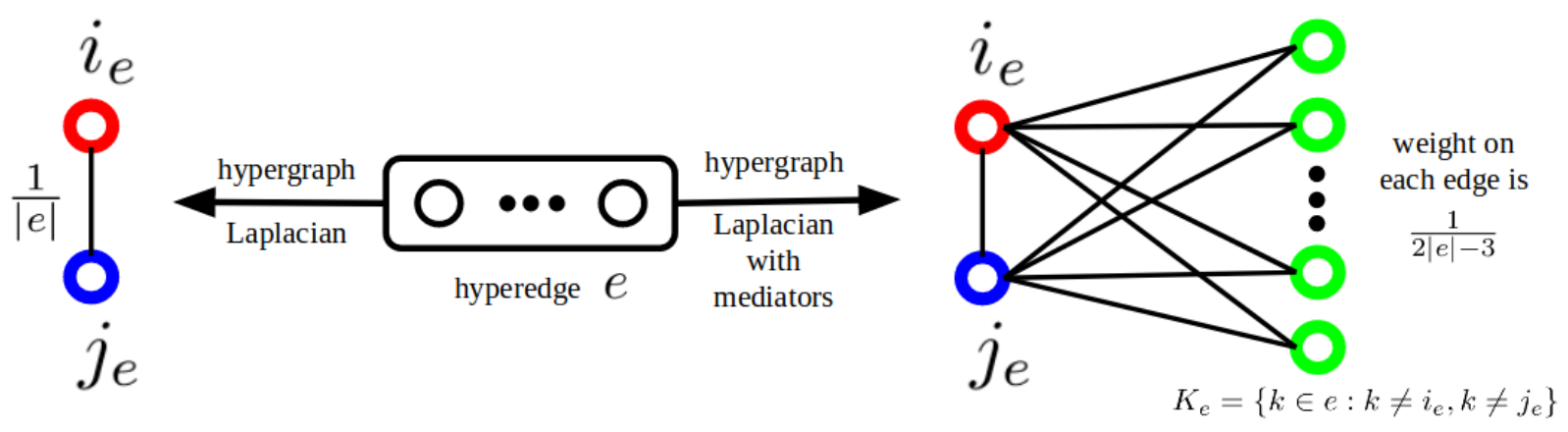
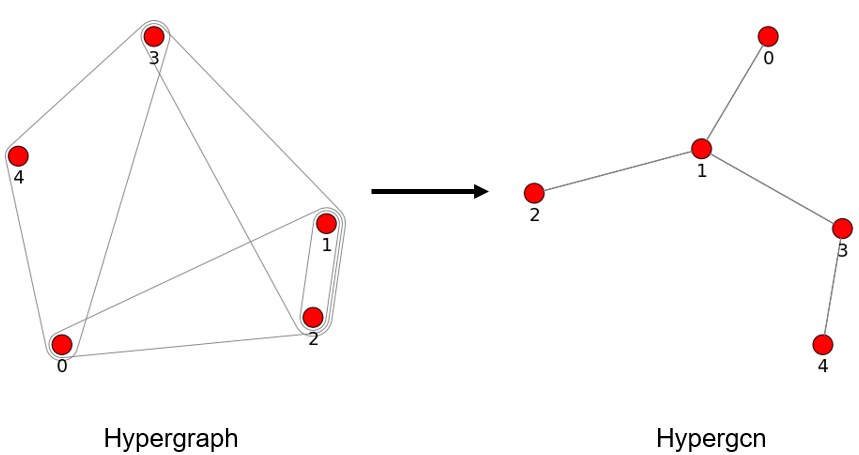
In the HyperGCN paper, the authors also describe a method to reduce the hyperedges in the hypergraph to the edges in the graph as the following figure.
>>> X = torch.tensor(([[0.6460, 0.0247],
                       [0.9853, 0.2172],
                       [0.7791, 0.4780],
                       [0.0092, 0.4685],
                       [0.9049, 0.6371]]))
>>> g = dhg.Graph.from_hypergraph_hypergcn(hg, X)
>>> g
Graph(num_v=5, num_e=4)
>>> g.e
([(0, 2), (2, 3), (1, 2), (3, 4)], [0.3333333432674408, 0.3333333432674408, 0.5, 0.3333333432674408])
>>> g.A.to_dense()
tensor([[0.0000, 0.0000, 0.3333, 0.0000, 0.0000],
        [0.0000, 0.0000, 0.5000, 0.0000, 0.0000],
        [0.3333, 0.5000, 0.0000, 0.3333, 0.0000],
        [0.0000, 0.0000, 0.3333, 0.0000, 0.3333],
        [0.0000, 0.0000, 0.0000, 0.3333, 0.0000]])
>>> g = dhg.Graph.from_hypergraph_hypergcn(hg, X, with_mediator=True)
>>> g
Graph(num_v=5, num_e=6)
>>> g.e
([(1, 2), (0, 1), (2, 3), (1, 3), (3, 4), (0, 3)], [0.3333333432674408, 0.3333333432674408, 0.3333333432674408, 0.3333333432674408, 0.3333333432674408, 0.3333333432674408])
>>> g.A.to_dense()
tensor([[0.0000, 0.3333, 0.0000, 0.3333, 0.0000],
        [0.3333, 0.0000, 0.3333, 0.3333, 0.0000],
        [0.0000, 0.3333, 0.0000, 0.3333, 0.0000],
        [0.3333, 0.3333, 0.3333, 0.0000, 0.3333],
        [0.0000, 0.0000, 0.0000, 0.3333, 0.0000]])
Building Directed Graph
A directed graph is a graph with directed edges, where the edge (x, y) and edge (y, x) can exist simultaneously in the structure.
It can be constructed by the following methods:
Edge list (default)
dhg.DiGraphAdjacency list
dhg.DiGraph.from_adj_list()Features with k-Nearest Neighbors
dhg.DiGraph.from_feature_kNN()
Common Methods
Note
The directed graph also support merging duplicated edges with merge_op parameter in construction or adding edges.
Construct a directed graph from edge list with dhg.DiGraph
>>> import dhg
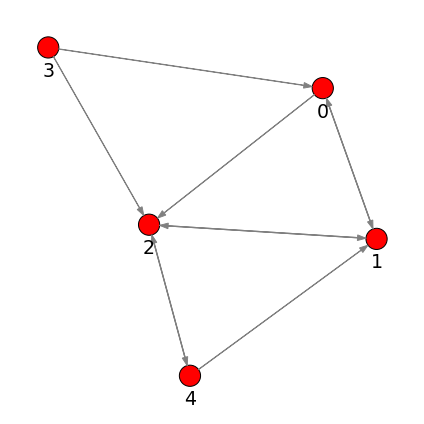
>>> g = dhg.DiGraph(5, [(0, 3), (2, 4), (4, 2), (3, 1)])
>>> g
Directed Graph(num_v=5, num_e=4)
>>> g.e
([(0, 3), (2, 4), (4, 2), (3, 1)], [1.0, 1.0, 1.0, 1.0])
>>> # print the adjacency matrix
>>> g.A.to_dense()
tensor([[0., 0., 0., 1., 0.],
        [0., 0., 0., 0., 0.],
        [0., 0., 0., 0., 1.],
        [0., 1., 0., 0., 0.],
        [0., 0., 1., 0., 0.]])
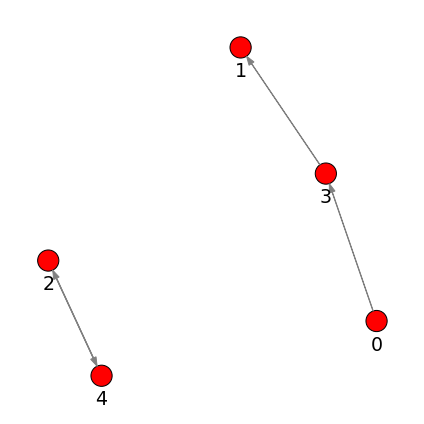
You can find that the adjacency matrix of the directed graph is not symmetric.
Construct a directed graph from adjacency list with dhg.DiGraph.from_adj_list()
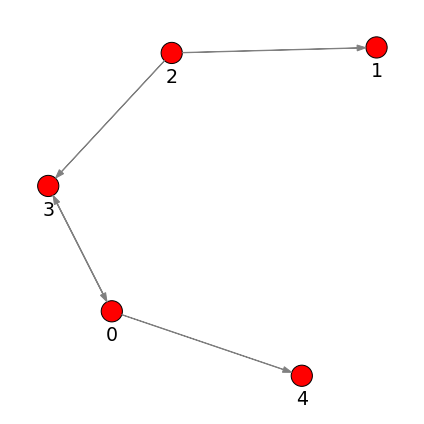
>>> g = dhg.DiGraph.from_adj_list(5, [(0, 3, 4), (2, 1, 3), (3, 0)])
>>> g
Directed Graph(num_v=5, num_e=5)
>>> g.e
([(0, 3), (0, 4), (2, 1), (2, 3), (3, 0)], [1.0, 1.0, 1.0, 1.0, 1.0])
>>> # print the adjacency matrix
>>> g.A.to_dense()
tensor([[0., 0., 0., 1., 1.],
        [0., 0., 0., 0., 0.],
        [0., 1., 0., 1., 0.],
        [1., 0., 0., 0., 0.],
        [0., 0., 0., 0., 0.]])
Construct a directed graph from feature k-Nearest Neighbors with dhg.DiGraph.from_feature_kNN()
>>> X = torch.tensor(([[0.6460, 0.0247],
                       [0.9853, 0.2172],
                       [0.7791, 0.4780],
                       [0.0092, 0.4685],
                       [0.9049, 0.6371]]))
>>> g = dhg.DiGraph.from_feature_kNN(X, k=2)
>>> g
Directed Graph(num_v=5, num_e=10)
>>> g.e
([(0, 1), (0, 2), (1, 2), (1, 0), (2, 4), (2, 1), (3, 2), (3, 0), (4, 2), (4, 1)], [1.0, 1.0, 1.0, 1.0, 1.0, 1.0, 1.0, 1.0, 1.0, 1.0])
>>> g.A.to_dense()
tensor([[0., 1., 1., 0., 0.],
        [1., 0., 1., 0., 0.],
        [0., 1., 0., 0., 1.],
        [1., 0., 1., 0., 0.],
        [0., 1., 1., 0., 0.]], dtype=torch.float64)
Reduced from High-Order Structures
Welcome to contribute!
Building Bipartite Graph
A bipartite graph is a graph that contains two types of vertices and edges between them, whose partition has the parts vertex set \(\mathcal{U}\) and vertex set \(\mathcal{V}\). It can be constructed by the following methods:
Edge list (default)
dhg.BiGraphAdjacency list
dhg.BiGraph.from_adj_list()Hypergraph
dhg.BiGraph.from_hypergraph()
Common Methods
Note
The bipartite graph also support merging duplicated edges with merge_op parameter in construction or adding edges.
Construct a bipartite graph from edge list with dhg.BiGraph
>>> import dhg
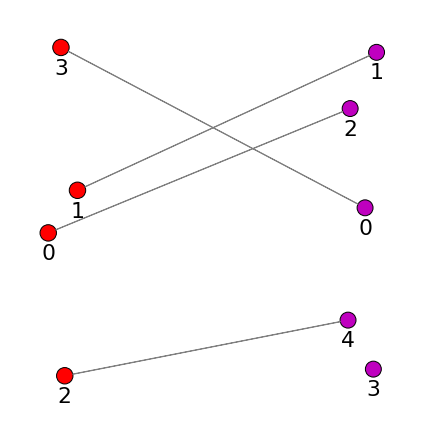
>>> g = dhg.BiGraph(5, 4, [(0, 3), (4, 2), (1, 1), (2, 0)])
>>> g
Bipartite Graph(num_u=5, num_v=4, num_e=4)
>>> g.e
([(0, 3), (4, 2), (1, 1), (2, 0)], [1.0, 1.0, 1.0, 1.0])
>>> # print the bipartite adjacency matrix
>>> g.B.to_dense()
tensor([[0., 0., 0., 1.],
        [0., 1., 0., 0.],
        [1., 0., 0., 0.],
        [0., 0., 0., 0.],
        [0., 0., 1., 0.]])
>>> # print the adjacency matrix
>>> g.A.to_dense()
tensor([[0., 0., 0., 0., 0., 0., 0., 0., 1.],
        [0., 0., 0., 0., 0., 0., 1., 0., 0.],
        [0., 0., 0., 0., 0., 1., 0., 0., 0.],
        [0., 0., 0., 0., 0., 0., 0., 0., 0.],
        [0., 0., 0., 0., 0., 0., 0., 1., 0.],
        [0., 0., 1., 0., 0., 0., 0., 0., 0.],
        [0., 1., 0., 0., 0., 0., 0., 0., 0.],
        [0., 0., 0., 0., 1., 0., 0., 0., 0.],
        [1., 0., 0., 0., 0., 0., 0., 0., 0.]])
Construct a bipartite graph from adjacency list with dhg.BiGraph.from_adj_list()
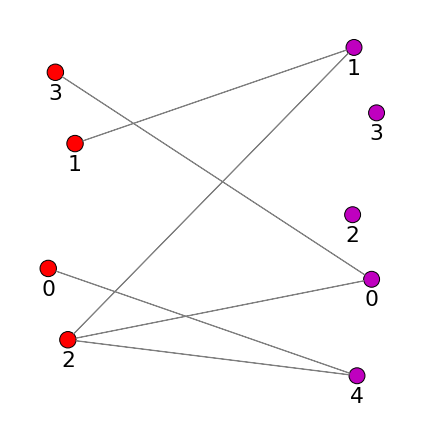
>>> g = dhg.BiGraph.from_adj_list(5, 4, [(0, 3, 2), (4, 2, 0), (1, 1, 2)])
>>> g
Bipartite Graph(num_u=5, num_v=4, num_e=6)
>>> g.e
([(0, 3), (0, 2), (4, 2), (4, 0), (1, 1), (1, 2)], [1.0, 1.0, 1.0, 1.0, 1.0, 1.0])
>>> g.B.to_dense()
tensor([[0., 0., 1., 1.],
        [0., 1., 1., 0.],
        [0., 0., 0., 0.],
        [0., 0., 0., 0.],
        [1., 0., 1., 0.]])
>>> g.A.to_dense()
tensor([[0., 0., 0., 0., 0., 0., 0., 1., 1.],
        [0., 0., 0., 0., 0., 0., 1., 1., 0.],
        [0., 0., 0., 0., 0., 0., 0., 0., 0.],
        [0., 0., 0., 0., 0., 0., 0., 0., 0.],
        [0., 0., 0., 0., 0., 1., 0., 1., 0.],
        [0., 0., 0., 0., 1., 0., 0., 0., 0.],
        [0., 1., 0., 0., 0., 0., 0., 0., 0.],
        [1., 1., 0., 0., 1., 0., 0., 0., 0.],
        [1., 0., 0., 0., 0., 0., 0., 0., 0.]])
Reduced from High-Order Structures
We first define a hypergraph as:
>>> hg = dhg.Hypergraph(5, [(0, 1, 2), (1, 3, 2), (1, 2), (0, 3, 4)])
>>> hg.e
([(0, 1, 2), (1, 2, 3), (1, 2), (0, 3, 4)], [1.0, 1.0, 1.0, 1.0])
>>> # print hypergraph incidence matrix
>>> hg.H.to_dense()
tensor([[1., 0., 0., 1.],
        [1., 1., 1., 0.],
        [1., 1., 1., 0.],
        [0., 1., 0., 1.],
        [0., 0., 0., 1.]])
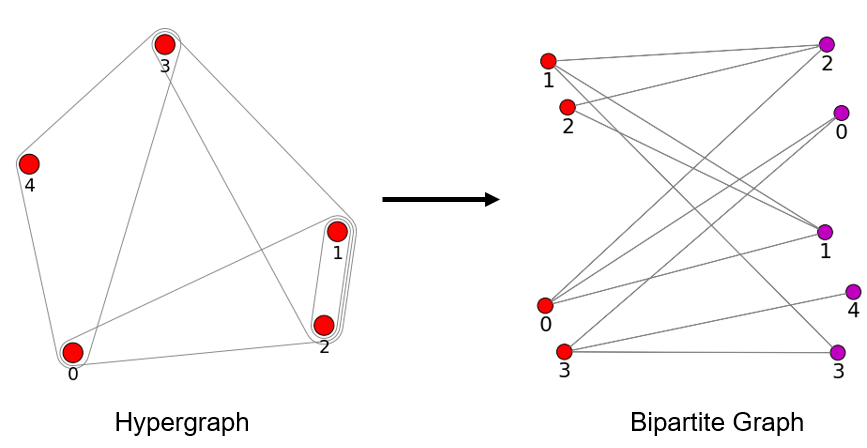
Construct a bipartite graph from hypergraph with dhg.BiGraph.from_hypergraph()
>>> g = dhg.BiGraph.from_hypergraph(hg, vertex_as_U=True)
>>> g
Bipartite Graph(num_u=5, num_v=4, num_e=11)
>>> g.e
([(0, 0), (1, 0), (2, 0), (1, 1), (2, 1), (3, 1), (1, 2), (2, 2), (0, 3), (3, 3), (4, 3)], [1.0, 1.0, 1.0, 1.0, 1.0, 1.0, 1.0, 1.0, 1.0, 1.0, 1.0])
>>> g.B.to_dense()
tensor([[1., 0., 0., 1.],
        [1., 1., 1., 0.],
        [1., 1., 1., 0.],
        [0., 1., 0., 1.],
        [0., 0., 0., 1.]])
>>> g = dhg.BiGraph.from_hypergraph(hg, vertex_as_U=False)
>>> g
Bipartite Graph(num_u=4, num_v=5, num_e=11)
>>> g.e
([(0, 0), (0, 1), (0, 2), (1, 1), (1, 2), (1, 3), (2, 1), (2, 2), (3, 0), (3, 3), (3, 4)], [1.0, 1.0, 1.0, 1.0, 1.0, 1.0, 1.0, 1.0, 1.0, 1.0, 1.0])
>>> g.B.to_dense()
tensor([[1., 1., 1., 0., 0.],
        [0., 1., 1., 1., 0.],
        [0., 1., 1., 0., 0.],
        [1., 0., 0., 1., 1.]])
High-Order Structures
Currently, DHG’s high-order structures include hypergraph. In the future, we will add more high-order structures, such as directed hypergraph.
Building Hypergraph
A hypergraph is a hypergraph with no direction information in each hyperedge. Each hyperedge in a hypergraph can connect more than two vertices, which can be indicated with a sub-set of total vertices. A hypergraph can be constructed by the following methods:
Hyperedge list (default)
dhg.HypergraphFeatures with k-Nearest Neighbors
dhg.Hypergraph.from_feature_kNN()Promoted from the low-order structures
k-Hop Neighbors of vertices in a graph
dhg.Hypergraph.from_graph_kHop()Bipartite Graph
dhg.Hypergraph.from_bigraph()
Common Methods
Construct a hypergraph from edge list with dhg.Hypergraph
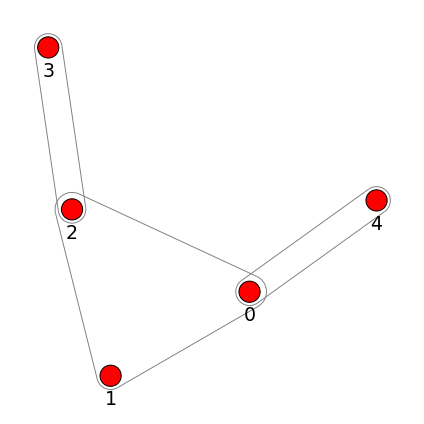
>>> hg = dhg.Hypergraph(5, [(0, 1, 2), (2, 3), (0, 4)])
>>> hg
Hypergraph(num_v=5, num_e=3)
>>> hg.e
([(0, 1, 2), (2, 3), (0, 4)], [1.0, 1.0, 1.0])
>>> # print the incidence matrix of the hypergraph
>>> hg.H.to_dense()
tensor([[1., 0., 1.],
        [1., 0., 0.],
        [1., 1., 0.],
        [0., 1., 0.],
        [0., 0., 1.]])
Important
Each hyperedge in the hypergraph is an unordered set of vertices, which means that (0, 1, 2), (0, 2, 1), and (2, 1, 0) are all the same hyperedge.
>>> hg = dhg.Hypergraph(5, [(0, 2, 1), (2, 3), (0, 4)])
>>> hg.e
([(0, 1, 2), (2, 3), (0, 4)], [1.0, 1.0, 1.0])
>>> hg.H.to_dense()
tensor([[1., 0., 1.],
        [1., 0., 0.],
        [1., 1., 0.],
        [0., 1., 0.],
        [0., 0., 1.]])
>>> hg = dhg.Hypergraph(5, [(1, 0, 2), (2, 3), (0, 4)])
>>> hg.e
([(0, 1, 2), (2, 3), (0, 4)], [1.0, 1.0, 1.0])
>>> hg.H.to_dense()
tensor([[1., 0., 1.],
        [1., 0., 0.],
        [1., 1., 0.],
        [0., 1., 0.],
        [0., 0., 1.]])
Note
If the added hyperedges have duplicate hyperedges, those duplicate hyperedges will be automatically merged with specified merge_op.
>>> hg = dhg.Hypergraph(5, [(0, 1, 2), (2, 3), (2, 3), (0, 4)], merge_op="mean")
>>> hg.e
([(0, 1, 2), (2, 3), (0, 4)], [1.0, 1.0, 1.0])
>>> hg = dhg.Hypergraph(5, [(0, 1, 2), (2, 3), (2, 3), (0, 4)], merge_op="sum")
>>> hg.e
([(0, 1, 2), (2, 3), (0, 4)], [1.0, 2.0, 1.0])
>>> hg.add_hyperedges([(0, 2, 1), (0, 4)], merge_op="mean")
>>> hg.e
([(0, 1, 2), (2, 3), (0, 4)], [1.0, 2.0, 1.0])
>>> hg.add_hyperedges([(0, 2, 1), (0, 4)], merge_op="sum")
>>> hg.e
([(0, 1, 2), (2, 3), (0, 4)], [2.0, 2.0, 2.0])
You can find the weight of the last hyperedge is 1.0 and 2.0, if you set the merge_op to mean and sum, respectively.
Construct a hypergraph from feature k-Nearest Neighbors with dhg.Hypergraph.from_feature_kNN()
>>> X = torch.tensor([[0.0658, 0.3191, 0.0204, 0.6955],
                      [0.1144, 0.7131, 0.3643, 0.4707],
                      [0.2250, 0.0620, 0.0379, 0.2848],
                      [0.0619, 0.4898, 0.9368, 0.7433],
                      [0.5380, 0.3119, 0.6462, 0.4311],
                      [0.2514, 0.9237, 0.8502, 0.7592],
                      [0.9482, 0.6812, 0.0503, 0.4596],
                      [0.2652, 0.3859, 0.8645, 0.7619],
                      [0.4683, 0.8260, 0.9798, 0.2933],
                      [0.6308, 0.1469, 0.0304, 0.2073]])
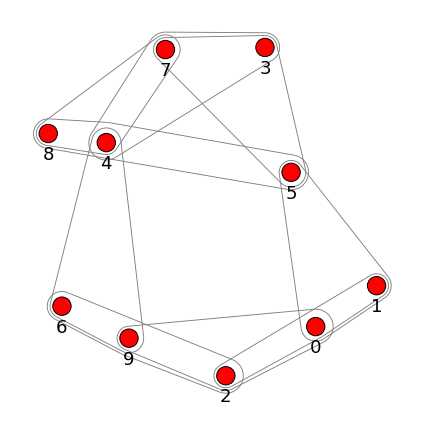
>>> hg = dhg.Hypergraph.from_feature_kNN(X, k=3)
>>> hg
Hypergraph(num_v=10, num_e=9)
>>> hg.e
([(0, 1, 2), (0, 1, 5), (0, 2, 9), (3, 5, 7), (4, 7, 8), (4, 6, 9), (3, 4, 7), (4, 5, 8), (2, 6, 9)], [1.0, 1.0, 1.0, 1.0, 1.0, 1.0, 1.0, 1.0, 1.0])
>>> hg.H.to_dense()
tensor([[1., 1., 1., 0., 0., 0., 0., 0., 0.],
        [1., 1., 0., 0., 0., 0., 0., 0., 0.],
        [1., 0., 1., 0., 0., 0., 0., 0., 1.],
        [0., 0., 0., 1., 0., 0., 1., 0., 0.],
        [0., 0., 0., 0., 1., 1., 1., 1., 0.],
        [0., 1., 0., 1., 0., 0., 0., 1., 0.],
        [0., 0., 0., 0., 0., 1., 0., 0., 1.],
        [0., 0., 0., 1., 1., 0., 1., 0., 0.],
        [0., 0., 0., 0., 1., 0., 0., 1., 0.],
        [0., 0., 1., 0., 0., 1., 0., 0., 1.]])
Note
Those duplicated hyperedges are merged with mean operation.
Prometed from Low-Order Structures
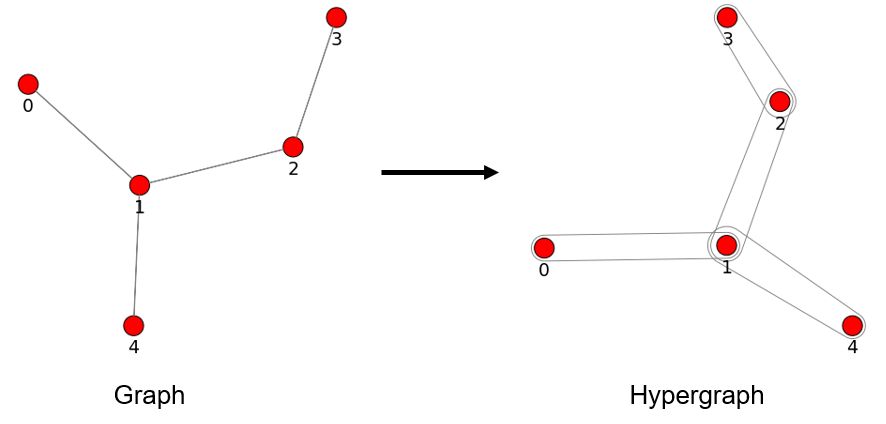
Construct a hypergraph from a graph with dhg.Hypergraph.from_graph()
>>> g = dhg.Graph(5, [(0, 1), (1, 2), (2, 3), (1, 4)])
>>> g.e
([(0, 1), (1, 2), (2, 3), (1, 4)], [1.0, 1.0, 1.0, 1.0])
>>> g.A.to_dense()
tensor([[0., 1., 0., 0., 0.],
        [1., 0., 1., 0., 1.],
        [0., 1., 0., 1., 0.],
        [0., 0., 1., 0., 0.],
        [0., 1., 0., 0., 0.]])
>>> hg = dhg.Hypergraph.from_graph(g)
>>> hg.e
([(0, 1), (1, 2), (2, 3), (1, 4)], [1.0, 1.0, 1.0, 1.0])
>>> hg.H.to_dense()
tensor([[1., 0., 0., 0.],
        [1., 1., 0., 1.],
        [0., 1., 1., 0.],
        [0., 0., 1., 0.],
        [0., 0., 0., 1.]])
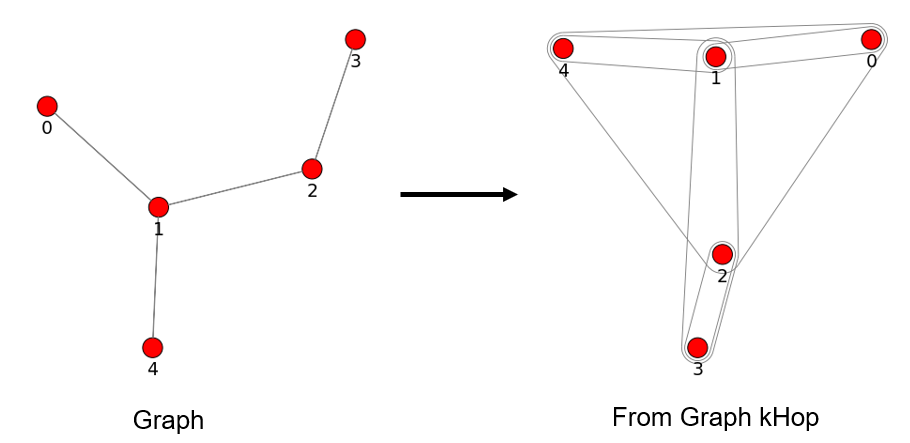
Construct a hypergraph from vertex’s k-Hop neighbors of a graph with dhg.Hypergraph.from_graph_kHop()
>>> g = dhg.Graph(5, [(0, 1), (1, 2), (2, 3), (1, 4)])
>>> g.e
([(0, 1), (1, 2), (2, 3), (1, 4)], [1.0, 1.0, 1.0, 1.0])
>>> g.A.to_dense()
tensor([[0., 1., 0., 0., 0.],
        [1., 0., 1., 0., 1.],
        [0., 1., 0., 1., 0.],
        [0., 0., 1., 0., 0.],
        [0., 1., 0., 0., 0.]])
>>> hg = dhg.Hypergraph.from_graph_kHop(g, k=1)
>>> hg.e
([(0, 1), (0, 1, 2, 4), (1, 2, 3), (2, 3), (1, 4)], [1.0, 1.0, 1.0, 1.0, 1.0])
>>> hg.H.to_dense()
tensor([[1., 1., 0., 0., 0.],
        [1., 1., 1., 0., 1.],
        [0., 1., 1., 1., 0.],
        [0., 0., 1., 1., 0.],
        [0., 1., 0., 0., 1.]])
>>> hg = dhg.Hypergraph.from_graph_kHop(g, k=2)
>>> hg.e
([(0, 1, 2, 4), (0, 1, 2, 3, 4), (1, 2, 3)], [1.0, 1.0, 1.0])
>>> hg.H.to_dense()
tensor([[1., 1., 0.],
        [1., 1., 1.],
        [1., 1., 1.],
        [0., 1., 1.],
        [1., 1., 0.]])
Construct a hypergraph from a bipartite graph with dhg.Hypergraph.from_bigraph()
>>> g = dhg.BiGraph(4, 3, [(0, 1), (1, 1), (2, 1), (3, 0), (1, 2)])
>>> g
Bipartite Graph(num_u=4, num_v=3, num_e=5)
>>> g.e
([(0, 1), (1, 1), (2, 1), (3, 0), (3, 2)], [1.0, 1.0, 1.0, 1.0, 1.0])
>>> g.B.to_dense()
tensor([[0., 1., 0.],
        [0., 1., 0.],
        [0., 1., 0.],
        [1., 0., 1.]])
>>> hg = dhg.Hypergraph.from_bigraph(g, U_as_vertex=True)
>>> hg
Hypergraph(num_v=4, num_e=3)
>>> hg.e
([(3,), (0, 1, 2), (1,)], [1.0, 1.0, 1.0])
>>> hg.H.to_dense()
tensor([[0., 1., 0.],
        [0., 1., 1.],
        [0., 1., 0.],
        [1., 0., 0.]])
>>> hg = dhg.Hypergraph.from_bigraph(g, U_as_vertex=False)
>>> hg
Hypergraph(num_v=3, num_e=3)
>>> hg.e
([(1,), (1, 2), (0,)], [1.0, 1.0, 1.0])
>>> hg.H.to_dense()
tensor([[0., 0., 1.],
        [1., 1., 0.],
        [0., 1., 0.]])